


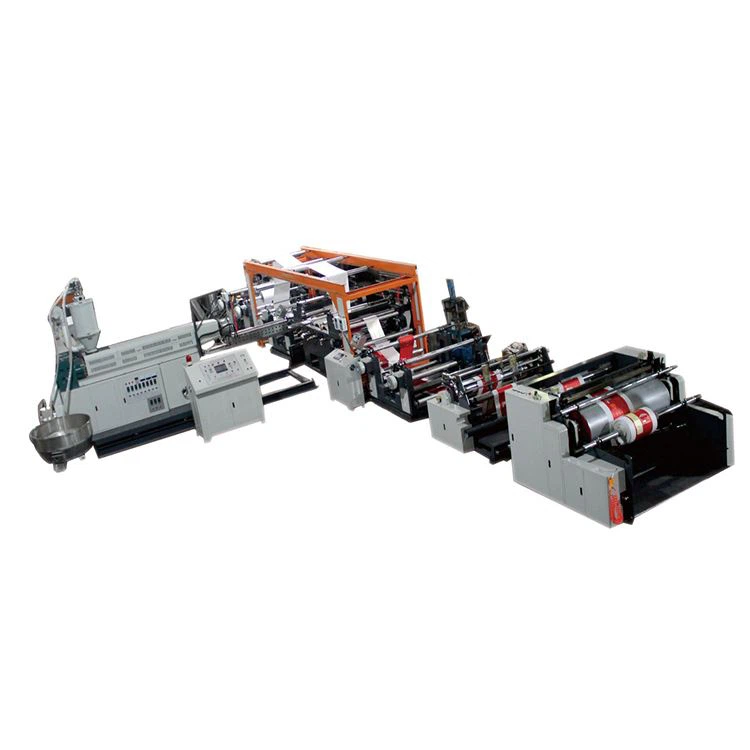
Polypropylene woven bag production process polypropylene woven bag complete production line includes: Drying mixer, drawing unit, winding machine, circular loom, printing machine, bag cutting machine, sewing machine.
Advantages of PP Woven Bag Production Line
Cost-effective
A pp woven bag production line is a low-cost solution for businesses that demand a continuous supply of pp woven bags. Businesses can save significant money on packing while maintaining high quality using this equipment.
Customizable
Businesses can customize the size, design, and print of their bags using a pp woven bag production line. This guarantees that the bags match the specific needs of the company and improve the brand’s image.
Increased production capacity
A pp woven bag production line can create a huge number of bags, decreasing the requirement for manual labor. This not only boosts capacity but also ensures faster delivery times.
Durable and environmentally friendly
Pp woven bag production line are known for their durability and environmental friendliness. They are reusable and recyclable, reducing waste and the environmental impact.


Why Choose Us
Our history
Our company is an enterprise recognized by the state, integrating scientific research, manufacture, sale and import and export business.
Our factory
Our company specializes in manufacturing pp woven fabric production lines, woven bag cutting and sewing machines, laminating machines,printing machines, circular loom and other plastic machinery and equipment.
Our product
Pp woven fabric production lines, woven bag cutting and sewing machines, laminating machines,printing machines, circular loom.
Our service
The equipment is guaranteed for one year and the electrical part is guaranteed for half a year.
PP Woven Bag Production Line Manufacturing Process
Raw material preparation
The production of pp woven bags starts with the preparation of the raw materials, which typically include high-quality polypropylene granules, color masterbatch, and other additives. The granules are melted and mixed together to form a homogenous mixture, which is then passed through an extruder to produce a continuous plastic film. The temperature, speed, and pressure of the extruder must be precisely controlled to ensure that the film is of the correct thickness and strength. The use of high-quality raw materials is essential for producing durable, strong bags that can withstand the weight of the contents and handling during transportation.
Extruding & drawing
After the film has been produced, it is then extruded and drawn to increase its strength and stability. The film is extruded through a die, and the speed and pressure of the extruder are closely monitored to ensure that the film is of the correct thickness. The drawing process further increases the film's strength and stability, which is critical for ensuring the bags are strong enough to withstand the weight of the contents and handling during transportation.
Weaving
The next step is weaving the plastic film with a woven fabric, such as polypropylene, to create a laminated material. This process involves using high-speed weaving machines to interweave the film and fabric together, producing a strong and durable material suitable for making bags. The weaving process must be accurately controlled to ensure that the fabric and film are properly interwoven and that the final product is of the correct thickness and strength.
Winding
After the laminated material has been created, it is then wound onto a large spool for storage and protection. This step helps ensure that the material remains in good condition until it is needed for the next stage, and makes it easier to manage the material, reducing the risk of damage during transportation and storage.
Cutting & sewing
The laminated material is then cut into the desired size and shape, and the edges are sewn together to create the final bags. This step is usually performed using specialized cutting and sewing machines, which are equipped to handle heavy-duty materials and produce consistent results. The cutting and sewing process must be executed with care to ensure that the bags are of the correct size and shape, and that the seams are strong enough to withstand the weight of the contents and handling during transportation.
Printing
If desired, printing can be done on the bags using rotogravure or flexo printing methods. This printing can be done on one or both sides of the bags, and the customer chooses the design. Printing on the bags can include logos, branding, and other information that is useful for the customer or end-user. The printing process must be executed with care to ensure that the printing is of high quality, and that the colors are vibrant and accurate.
Inspection
The final bags are thoroughly inspected for any defects, ensuring that only high-quality products are sent to the customer. This step is critical in ensuring that the customer receives a product that meets their expectations and requirements, including the correct size, shape, color, and print, and is free of any defects or damages.
Packing
The final step is to carefully package the bags for shipment to the customer. The bags are packaged to ensure they reach the customer in perfect condition and minimize the risk of damage during transportation. The packaging process is critical in ensuring that the customer receives a high-quality product that meets their expectations and requirements.
Application of PP Woven Bag Production Line



Agricultural products packaging
Feed woven bags, chemical woven bags, putty powder woven bags, urea woven bags, vegetable mesh bags, fruit mesh bags, etc.
Agricultural products packaging
Feed woven bags, chemical woven bags, putty powder woven bags, urea woven bags, vegetable mesh bags, fruit mesh bags, etc.
Food packaging
Rice woven bags, flour woven bags, corn woven bags, and other woven bags.
Geotechnical engineering
Since the development of geotextiles in the 1980s has broadened the application fields of plastic woven fabrics, which are widely used in small water conservancies, electric power, highways, railways, seaports, mining construction, and military engineering construction. In these projects, geosynthetics have the functions of filtration, drainage, reinforcement, isolation, and seepage prevention.
Temporary tents, parasols, various travel bags, and travel bags in the tourism industry all have plastic-woven applications
Various tarpaulins are widely used as covering materials for transportation and storage. Common ones include logistics bags and logistics packaging bags, shipping bags, shipping packaging bags, etc.
Daily necessities
Such as shopping bags, supermarket shopping bags, supermarket environmentally friendly shopping bags; freight woven bags for logistics transportation, and logistics woven bags.
Woven bags are indispensable for flood control materials
Woven bags are also indispensable in the construction of dams, river banks, railways, and highways. They are flood control woven bags, drought prevention woven bags, and flood control woven bags.
Specially woven bags
Due to special factors, some industries need to use woven bags that are not usually used, such as carbon black bags. The biggest feature of carbon black bags: Is sun protection. That is, carbon black woven bags have stronger sun protection ability than ordinary woven bags, and ordinary woven bags cannot withstand long-term exposure to the sun.
How to Distinguish the Quality of Polypropylene Woven Bags
Generally speaking, high-quality polypropylene woven bags are non-toxic and tasteless, and have almost no harm to the human body. Although they are made of various chemical plastics, they are environmentally friendly and have greater recycling rates.
From the appearance to distinguish good from bad, you can see whether there are skipping ropes and colors, whether they meet the requirements of woven fabrics. From a professional point of view, whether it is recycled materials, semi-permeable materials or woven fabrics of new materials. Woven bags made of this new material are of good quality and can be reused. Polypropylene woven bags made of original materials can be used outdoors. More than a few months.
Generally speaking, the quality of polypropylene woven bags made of recycled materials is poor, and polypropylene woven bags made of recycled materials are neither white nor transparent. We can also shake it again to see if there is any debris. The point is whether the smell is strong. The recycled polypropylene woven bags are made from waste plastics and industrial waste. Most of them are cloudy, sticky to the touch, and have a strong plastic smell.
The naked eye can only identify it roughly, and whether it needs to be tested for accuracy. Carry out appearance quality, tensile load, drop test, heat resistance, sanitary performance and other tests. If the surface wrinkles are not obvious after flattening, we can rub it with our hands, the quality is better, and the hand feel is not good. The thickness and density can also be checked, and then pulled out to check the strength. The relative breaking force is significantly reduced for polypropylene woven bags of recycled materials.
If an auxiliary return material is added, the relative breaking force will be lower. The elongation at break is unstable, and the addition of recycled materials will affect the breaking rate. The brittleness of recycled materials polypropylene woven bags is significantly improved, especially the low temperature brittleness is worse, the electrical insulation is reduced, the impact resistance is reduced, the aging degree is improved, and the speed is accelerated.
Product features
|
Bag width |
350-600mm |
|
Bag length |
450-910mm |
|
Bag bottom width |
80-180mm |
|
Valve port length |
80-200mm |
|
Maximum production speed |
100 pcs/min |
|
Maximum unwinding diameter |
1200mm |
|
Power supply |
380V/3P/50HZ/A.C. |
|
Installed power |
85kW |
|
Dimensions (LxWxH) |
13000×8500×2500mm |
1. It can automatically cut, fold, sew, print and collect the blank woven bag;
2. It adopts touch screen setting, plc control, servo motor drive and precise control system;
3. After hot cutting, the bag does not adhere and is easy to open;
4. The bottom of the bag can be folded with single or double edges, the edge can be folded evenly, and the length of the thread can be adjusted;
5. Electric rewinding, pneumatic rectifying device, easy to operate, labor-saving, automatic counting, bags can be stacked and sent, the number of adjustable;
6. The printing roller can track and separate automatically, and the ink transfer roller and the printing plate can be separated and closed.

The pp woven bag production line operates on a semi-automatic or fully automatic basis, depending on its type. Theprocess involves the following steps:
Extrusion: Polypropylene resin is fed into the extruder, where it is heated and melted. The molten polymer is then forcedthrough a spinneret, forming long filaments.
Weaving: The filaments are woven together using high-speed looms to create a sturdy fabric.
Printing: If required, the woven fabric is passed through a printing section, where designs and information are printed using flexographic or gravure printing techniques.
Cutting and stitching: The printed fabric is cut into individual bag sizes, and the bags are stitched at the edges for added Strength.
How to Choose the Right PP Woven Bag Production Line
When selecting a pp woven bag production line, consider the following factors:
Production capacity
Determine the number of bags required per day and choose a machine that can meet this demand efficiently.
Automation level
Evaluate the level of automation based on your production volume and available workforce.
Quality of bags produced
Inspect samples produced by the machine to ensure they meet your desired quality standards.
Energy efficiency
Choose a machine that optimizes energy usage to reduce operational costs.
After-sales support and warranty
Select a machine from a reliable manufacturer that offers good after-sales support and warranty coverage.
Our Factory
Our company specializes in manufacturing pp woven fabric production lines, non woven bag making machines, woven bag cutting and sewing machines, laminating machines, printing machines,circular loom and other plastic machinery and equipment. Our products have been sold throughout the country and have been exported to turkey, mexico, brazil, zimbabwe, russia, vietnam, indonesia and other countries and regions.


FAQ
Q: What is the production process of pp woven bags?
Q: What is a woven pp bag?
Q: What is the raw material used in pp woven bags?
Q: How are plastic bags made step by step?
Q: What is the difference between hdpe and pp woven bags?
Q: What is the difference between pp and pe bags?
Q: What are the different types of woven bags?
Q: Where are pp bags used?
Q: Is woven pp waterproof?
Q: Where are pp bags used?
Q: Are polypropylene bags good?
Q: Is woven polypropylene safe?
Q: Are woven polypropylene bags eco friendly?
Q: What does pp mean bag?
Q: Should I avoid polypropylene?
Q: Can pp woven bags be recycled?
Q: What is the raw material of pp bags?
Q: How to seal poly woven bags?
Q: How long will polypropylene last?
Q: Are woven polypropylene bags waterproof?
As one of the most professional pp woven bag production line manufacturers and suppliers in China, we're featured by quality products and low price. Please rest assured to buy cheap pp woven bag production line made in China here from our factory. For customized service, contact us now.
large laminating machine, solvent base lamination machine, cardboard laminating machine